Disclosure: the header photo for this story was created or materially edited with AI.
What happened
How can one of America's smallest states have 565 different towns? The answer says a lot about New Jersey.
Drive through New Jersey for 20 minutes and you'll probably pass through three or four different municipalities.
One moment you're in Nutley. A mile later you're in Belleville. A few turns after that, you're in Newark.
Each has its own mayor, police department, public works, zoning board, local government, and community identity.
For people from other states, it can seem unnecessarily complicated.
For New Jersey, it's just how things work.
The numbers really are unusual
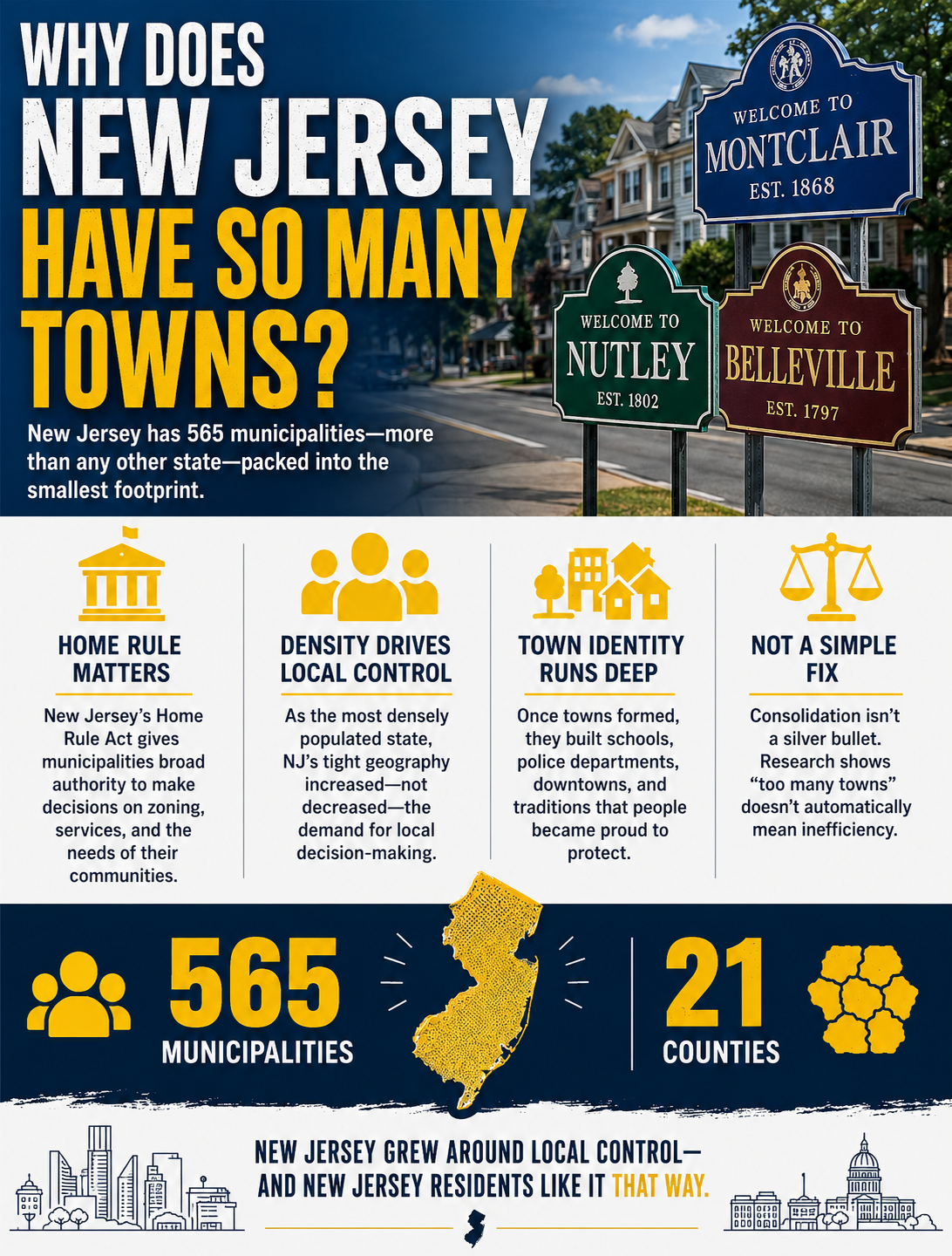
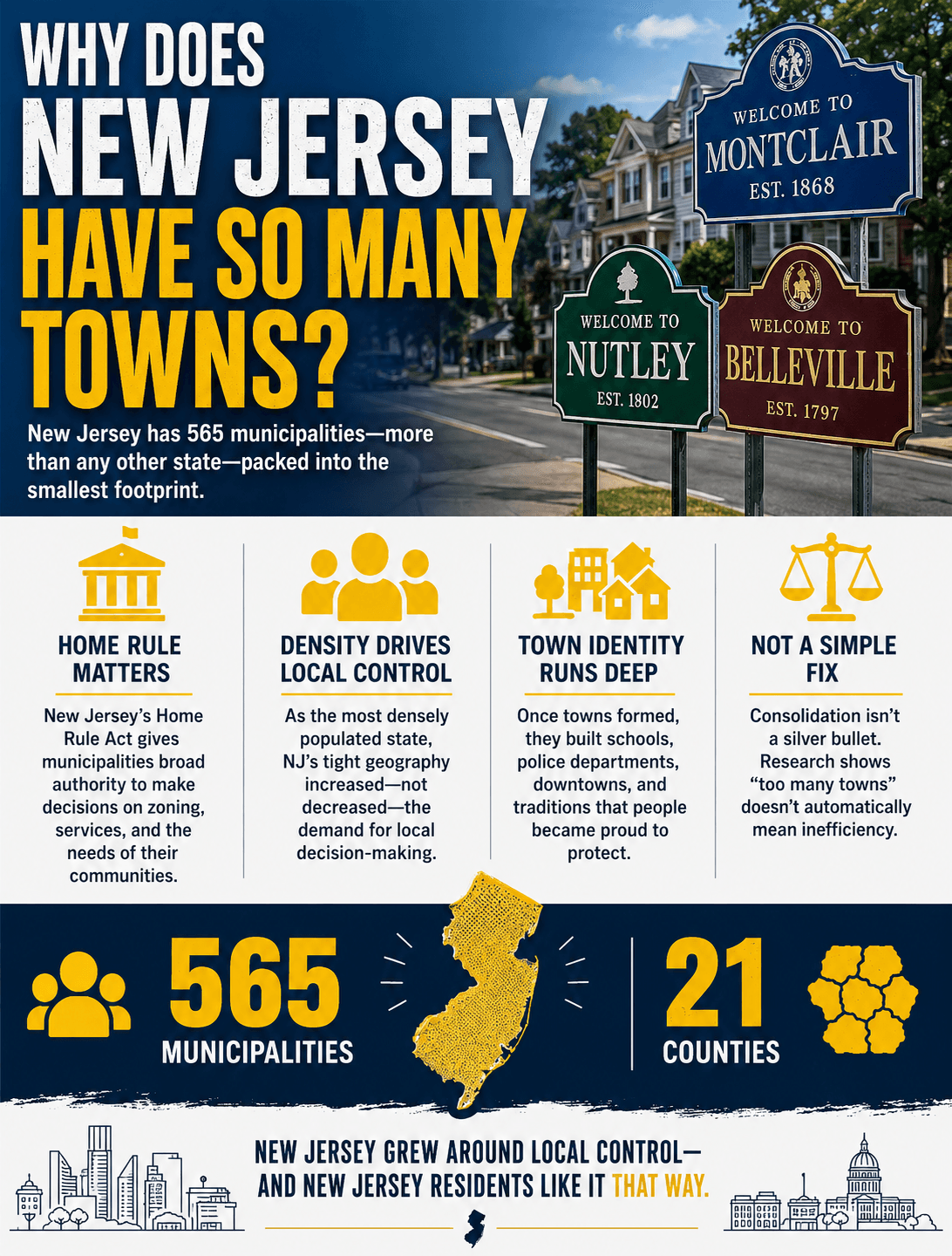
New Jersey has 565 municipalities spread across just 21 counties, according to NJ.gov and the Office of the State Comptroller.
For one of the nation's smallest states by land area, that's an extraordinary level of local government. But the more interesting question isn't how many municipalities exist—it's why so many have survived.
The answer starts with home rule
New Jersey has long embraced the idea of home rule, giving municipalities broad authority to govern themselves.
State guidance explains that the Home Rule Act allows towns to adopt ordinances that address local needs and protect public welfare. The state's Hazard Mitigation Plan also identifies home rule as one of the foundations of New Jersey's local autonomy.
That means municipalities aren't simply lines on a map. They have real authority over zoning, planning, local services, development, and many of the decisions that shape everyday life.
Density didn't eliminate local government—it encouraged it
Many assume New Jersey's municipal map is simply the result of poor organization.
Research from Rutgers University suggests the reality is far more complicated.
As the nation's most densely populated state, New Jersey packed millions of people into a relatively small area. Instead of pushing communities together, that often strengthened the desire for separate local governments, allowing neighborhoods with different priorities to make their own decisions about growth, schools, taxes, and development.
In other words, more people living closer together often created more demand for local control—not less.
Town identity became part of New Jersey's culture
Once municipalities were established, they built identities that became difficult to dissolve.
Residents became attached to their schools, downtowns, police departments, parks, tax base, and local traditions.
Ask someone where they're from, and they're usually just as likely to answer Montclair, Cherry Hill, Fort Lee, Nutley, Freehold, or Cape May as they are to simply say New Jersey.
That strong sense of hometown identity isn't accidental. It's woven into how the state has governed itself for generations.
Would fewer towns solve everything?
Not necessarily.
Whenever New Jersey's property taxes or government spending become political issues, the conversation often turns to consolidation.
While maintaining hundreds of municipalities can create duplication and administrative costs, Rutgers researchers have argued that the common assumption that "too many towns equals inefficiency" oversimplifies a much more complex system.
Consolidation can produce savings in some situations, but every municipality has its own financial structure, services, history, and political realities. There isn't a one-size-fits-all solution.
So why does New Jersey have 565 municipalities?
Because the state developed around local control.
As communities grew, residents wanted decisions made close to home. Laws gave municipalities significant authority, those governments became permanent institutions, and generations of residents built strong identities around their hometowns.
That's why you can drive just a few miles and enter an entirely different municipality with its own government, services, and personality.
To outsiders, it may seem fragmented.
To New Jersey, it's simply part of what makes New Jersey... New Jersey.
Continue with related coverage
Use these archive links to keep following this story by location and topic.